
Many organisations contribute to the HRD Corp levy consistently, yet utilisation often happens only when deadlines approach or training requests arise. Without a clear HRD Corp levy strategy, levy usage becomes reactive focused on spending rather than impact.
Organisations that extract real value from the levy approach it differently. They plan ahead, align training to business needs, and treat the levy as a workforce capability investment, not an administrative task.
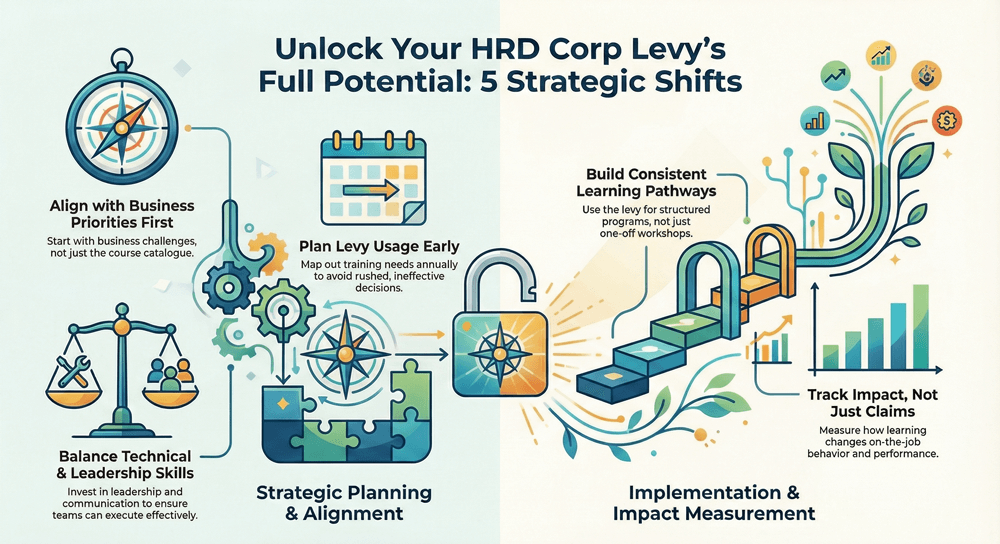
Below are five practical HRD Corp levy strategies commonly used by organisations that want measurable improvement in skills, leadership, and performance.
1. Align Levy Usage with Business Priorities, Not Just Training Availability
One of the most effective HRD Corp levy strategies is starting with business objectives, not course catalogues.
Instead of asking “What training is claimable?”, high-performing organisations ask:
-
What capabilities are limiting execution today?
-
What skills will be critical in the next 12 months?
-
Where are managers and teams struggling to perform consistently?
When training is aligned to real operational and leadership needs, levy utilisation produces visible results rather than attendance records.
2. Plan Levy Usage Early to Avoid Last-Minute Decisions
Many organisations wait until levy balances accumulate before acting. This often leads to rushed decisions, limited programme choices, and poor participant readiness.
A smarter HRD Corp levy strategy involves:
-
Mapping training needs early in the year
-
Scheduling programmes around business cycles
-
Allowing time for internal alignment and preparation
Early planning gives organisations control—over budget, programme quality, and learning outcomes.
3. Balance Technical Skills with Leadership and Execution Capability
While technical training is essential, organisations often underestimate the impact of leadership, communication, and execution gaps.
Effective levy strategies balance:
- Technical and functional skills
- Managerial and leadership development
- Behavioural and mindset capabilities
This ensures teams not only know what to do, but are able to execute, lead, and collaborate effectively under pressure.
4. Use the Levy to Build Consistency, Not One-Off Training
Another common mistake is treating training as isolated events. Organisations that see stronger results use levy funds to build consistent capability pathways.
This may include:
- Structured onboarding programmes
- Progressive leadership development
- Follow-up or reinforcement sessions
Consistency ensures learning is applied over time, rather than forgotten after a single workshop.
5. Track Utilisation and Learning Impact, Not Just Claims
Claiming levy funds is only part of the equation. Mature HRD Corp levy strategies include visibility on:
- Who attended which programmes
- What capabilities were targeted
- How learning translated into performance or behaviour change
Even simple tracking helps HR and management make better decisions about future training investments.
Final Thoughts
The HRD Corp levy is a mandatory contribution, but the value it delivers is optional. Organisations that approach levy usage strategically gain stronger teams, more confident leaders, and better execution without increasing training budgets.
The difference lies not in how much levy is available, but in how deliberately it is planned and applied.