Skills Can Be Taught But Attitude Determines Performance
When organisations talk about talent development, the conversation often revolves around skills. Technical competencies, certifications, and expertise are seen as indicators of capability.
However, many organisations discover a hard truth over time:
high skill does not always translate into high performance.
The difference often lies in attitude.
Understanding the Difference Between Skill and Attitude
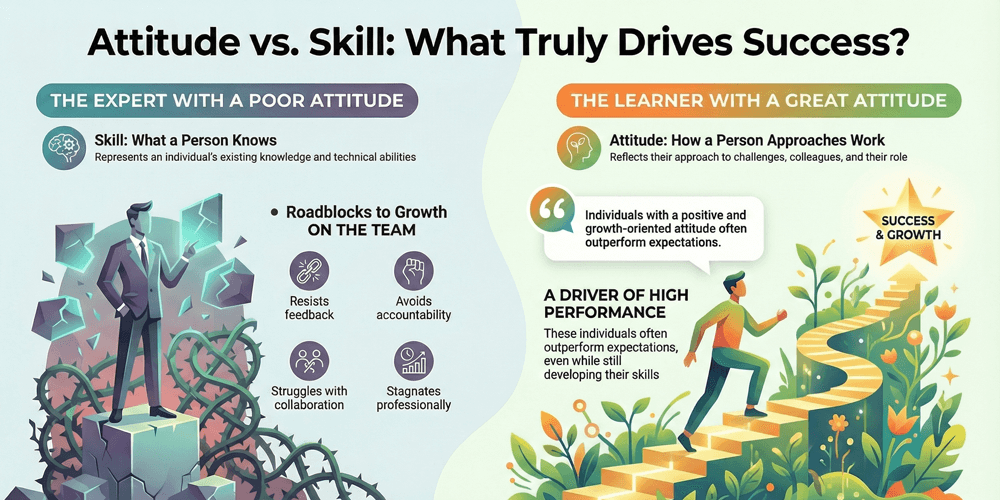
Skill refers to what a person knows and can do.
Attitude reflects how a person approaches work, challenges, and people.
An employee may possess excellent technical skills, but without the right attitude:
Collaboration becomes difficult
Accountability is avoided
On the other hand, individuals with a positive and growth-oriented attitude often outperform expectations even while still developing their skills.
Why Attitude Has a Bigger Impact on Organisational Culture
Attitude is contagious. In teams, it influences:
When attitude is misaligned, no amount of technical expertise can compensate for the damage it causes to morale and productivity.
Organisations that ignore attitude risk building teams that are competent but disconnected.
Skills Enable the Job, Attitude Sustains the Performance
This does not mean skills are unimportant. Skills enable individuals to perform tasks effectively. However, attitude sustains performance over time.
The most effective talent development strategies focus on:
When skills and attitude grow together, performance becomes consistent and sustainable.
Developing the Right Attitude Is a Leadership Responsibility
Attitude does not develop in isolation. It is shaped by:
The way success and failure are handled
Leaders play a critical role in modelling the behaviours they want to see. Talent grows when people feel supported, challenged, and trusted.
RWCT’s Approach to Talent Growth
At RWCT, we view talent development as a balance between capability and character. Our programmes are designed to develop not only skills, but also the mindset and behaviours that drive long-term performance.
Because when attitude aligns with skill, talent becomes an asset that truly moves the organisation forward.