

Workplace Culture Is Built Daily Not Written on Paper
Many organisations invest time and effort creating policies, values statements, and employee handbooks. These documents are important, but they do not define workplace culture on their own.
In reality, culture is shaped by what leaders do every day, not by what is written on paper.
Employees observe leadership behaviour closely. Over time, what leaders tolerate, reward, or ignore becomes the real culture of the organisation.
Why Leadership Has the Strongest Cultural Impact
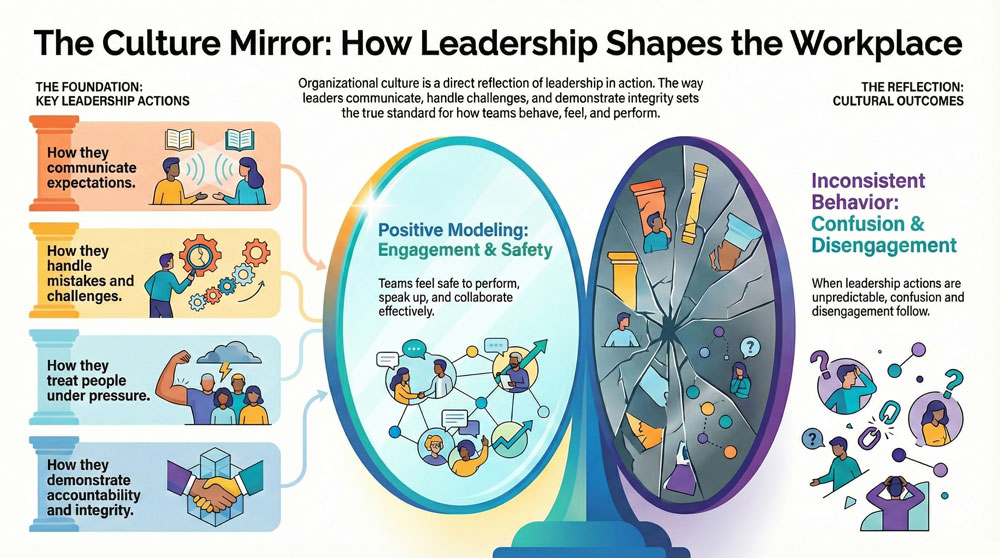
- How they communicate expectations
- How they handle mistakes and challenges
- How they treat people under pressure
- How they demonstrate accountability and integrity
When leaders model positive behaviours, teams feel safe to perform, speak up, and collaborate. When leadership behaviour is inconsistent, confusion and disengagement follow.
Culture, therefore, reflects leadership in action.
The Gap Between Stated Values and Lived Values
- Leaders do not consistently model stated values
- Performance is prioritised over people
- Short-term results override long-term development
Leadership Behaviour Sets the Standard for the Organisation
- Communicate clearly and respectfully, teams follow
- Take ownership, accountability spreads
- Show openness to feedback, learning increases
Conversely, if leaders avoid responsibility or resist change, these behaviours quickly cascade throughout the organisation.
Leadership is not just about decision-making, it is about setting behavioural standards.
Building Culture Through Intentional Leadership Development

RWCT’s View on Leadership and Culture
At RWCT, we believe workplace culture is a reflection of leadership capability. That is why our leadership development programmes focus not only on skills, but on behaviours that shape culture and performance.
Because when leaders grow, teams follow and organisations thrive.