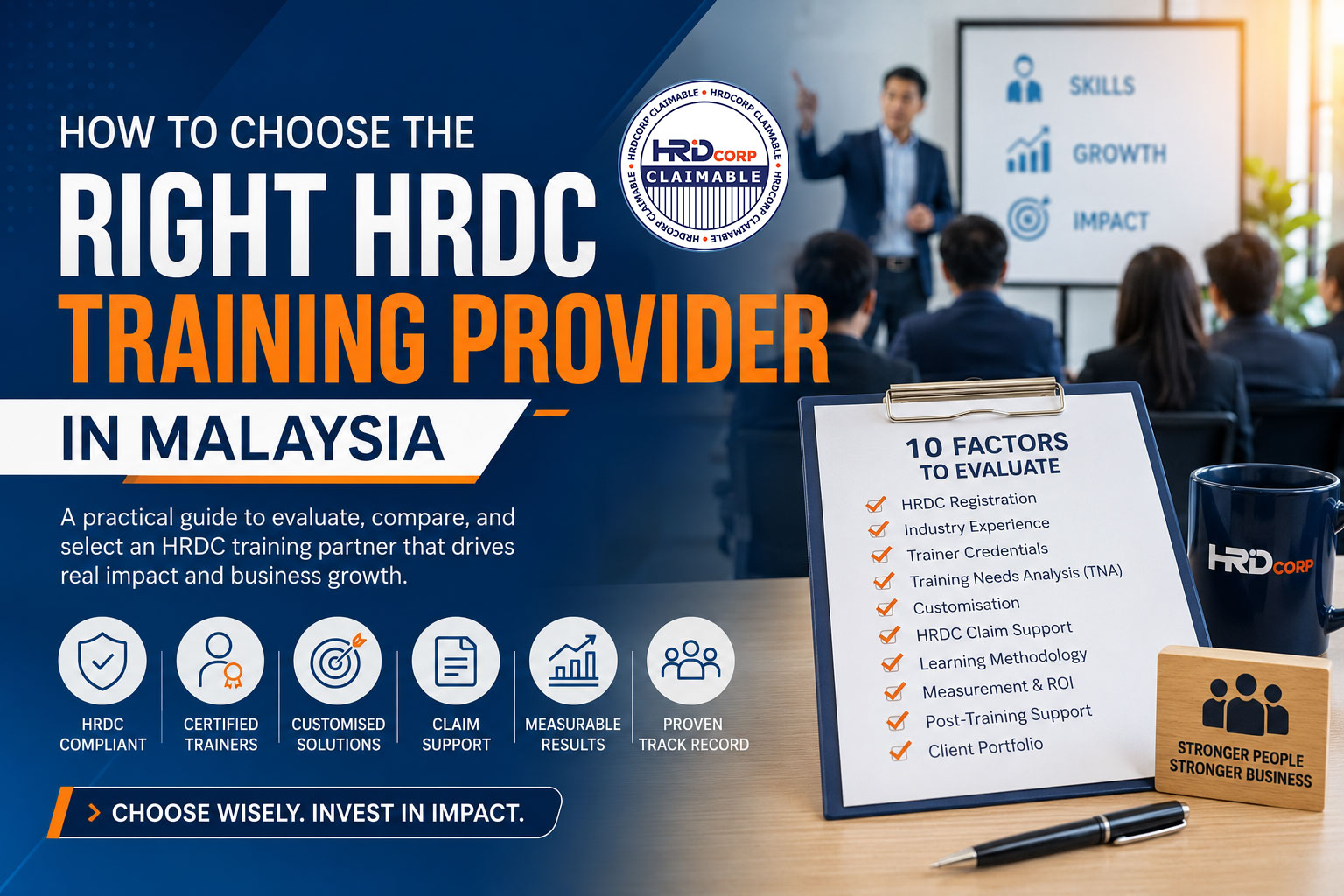
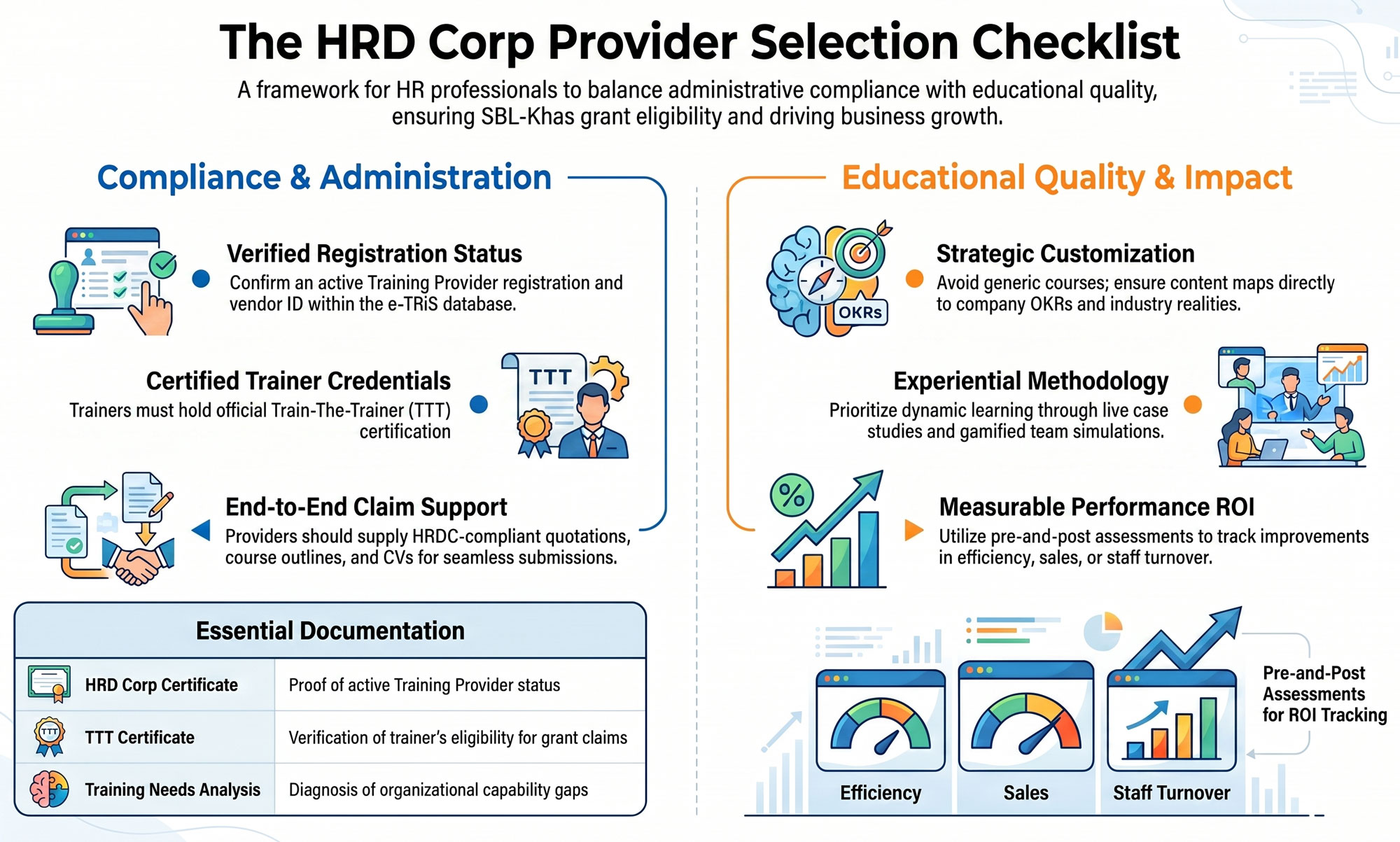
To choose the right HRDC training provider in Malaysia, employers must verify the provider’s active HRD Corp registration status, ensure all trainers possess certified Train-The-Trainer (TTT) credentials, evaluate their customization capabilities via Training Needs Analysis (TNA), and confirm their ability to provide seamless e-TRiS claim support.
In 2026, corporate development has shifted away from generic box-checking exercises. Forward-thinking companies are now treating their Human Resources Development Corporation (HRD Corp) levy as a strategic investment rather than a mandatory tax. With tightening market dynamics, building a high-efficiency talent engine is the ultimate competitive advantage.
This comprehensive guide outlines the exact parameters required to filter, evaluate, and select a corporate training partner that transforms your workforce and drives measurable business growth.
Table of Contents
What Is an HRDC Training Provider?
An HRDC training provider is an independent training institution, agency, or consultancy officially registered and approved by the Human Resources Development Corporation (HRD Corp) under the Ministry of Human Resources Malaysia.
These entities are authorized to conduct courses that allow registered employers to utilize their mandatory human resource levy. All transactions, grant approvals, and reimbursement claims are processed digitally through the government’s centralized e-TRiS portal.
Why Choosing the Right Provider Matters
Deploying your HRDC levy on sub-par training does more harm than good. It wastes valuable operational hours and induces “training fatigue” among your staff.
Choosing the right partner ensures:
- Zero Out-of-Pocket Risk: Clean compliance guarantees that your training grants under schemes like SBL-Khas are approved seamlessly without unexpected financial rejections.
- Strategic Target Alignment: The training actively solves real operational gaps—such as fixing team toxicity, upgrading leadership pipelines, or restructuring sales teams to operate with a leaner, high-output engine.
- Behavioral Transformation: True growth happens when employees transition from a passive “worker” mindset into an active “ownership” mindset.
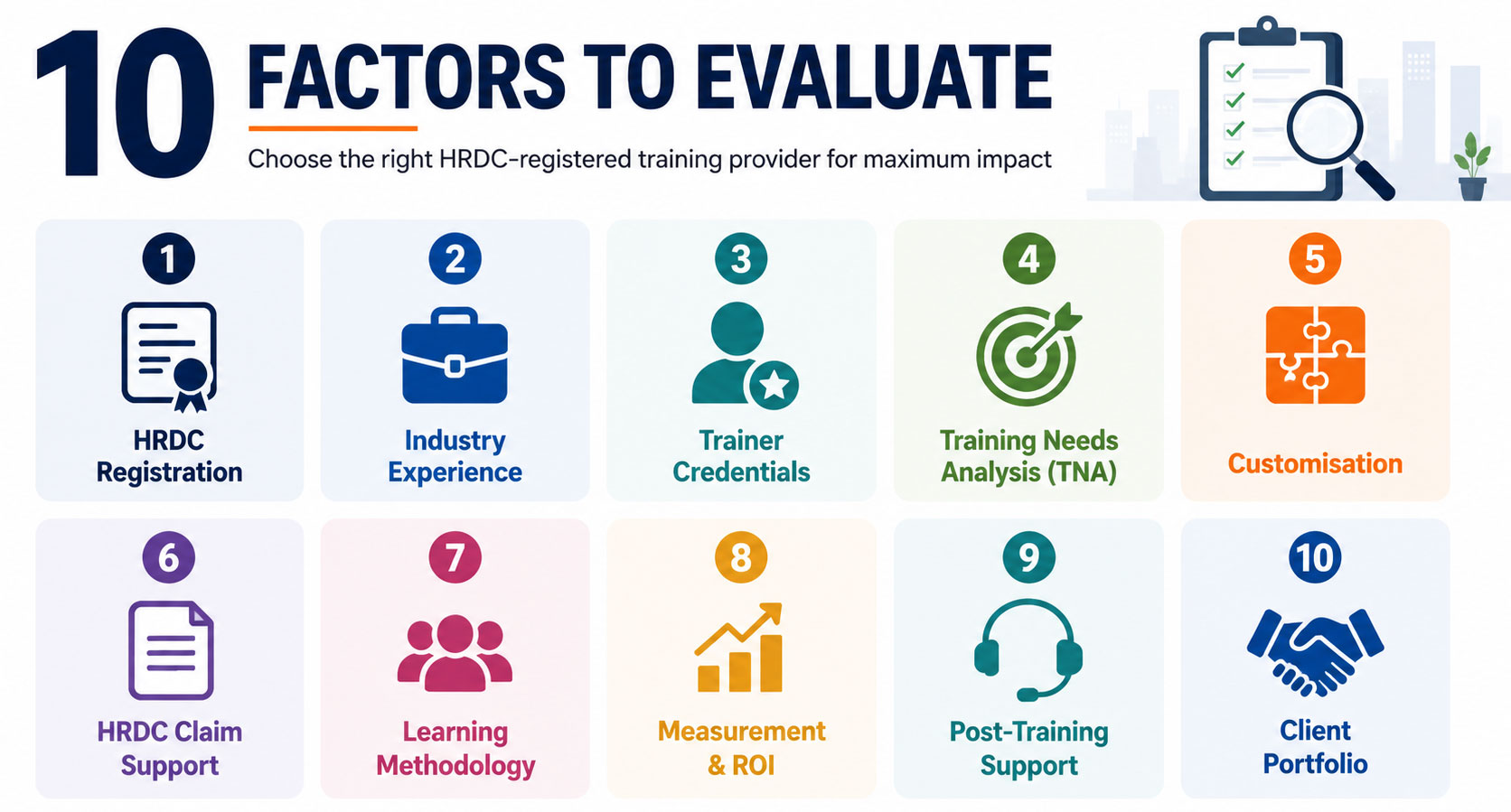
10 Factors to Evaluate
1. HRDC Registration
2. Industry Experience
3. Trainer Credentials
While the agency itself must be registered, the individual trainers assigned to your team must hold the official Train-The-Trainer (TTT) certification or a certified exemption code issued directly by HRD Corp. Without this specific credential, your SBL-Khas grant application cannot be processed.
4. Training Needs Analysis (TNA)
5. Customisation
6. HRDC Claim Support
7. Learning Methodology
8. Measurement & ROI
9. Post-Training Support
10. Client Portfolio
Common Mistakes
When burning through remaining year-end levy balances, employers frequently fall into these common pitfalls:
- The “Levy Clearing” Trap: Choosing courses arbitrarily just to empty the HRDC account before the deadline, resulting in zero long-term retention.
- Ignoring Trainer Backgrounds: Reviewing the company profile but failing to vet the specific trainer assigned to the project.
- Late Grant Submissions: Submitting applications on e-TRiS less than a 14 days before training begins, which risks rejection or delayed approvals.
Public Training vs In-House
| Criteria | Public Training Seminars | Customized In-House Training |
|---|---|---|
| Best Suited For | Individual upskilling or small team participation. | Full department alignment, company-wide capability development and business transformation. |
| Customization Level | Fixed curriculum with general industry examples. | Fully customized learning objectives, case studies and workshops aligned with your business goals. |
| Team Confidentiality | Participants attend alongside employees from different organizations. | High confidentiality for discussing internal processes, challenges and business strategies. |
| HRDC Logistics | Claims are submitted individually for each participant. | Single corporate claim processed under the HRDC SBL-Khas scheme. |
Checklist Before Hiring
- Verified active HRD Corp Training Provider status via e-TRiS.
- Received the trainer's certified TTT (Train-The-Trainer) certificate.
- Completed a comprehensive preliminary alignment call or TNA.
- Confirmed that the course outline explicitly reflects your team's development goals.
- Received an HRDC-compliant itemized quotation and formal invoice.
- Verified that your internal HRDC levy balance is sufficient to cover the program costs.
Frequently Asked Questions
Q: Can we claim the training costs if we submit the e-TRiS grant after the session is over?
Q: What is the SBL-Khas scheme?
Q: Are digital, remote, or hybrid corporate training sessions claimable?
Conclusion
Maximize your HRDC levy today.
If you are looking for an authorized HRD Corp registered training provider specializing in leadership transformation, structural alignment, and strategic corporate execution, Richworks Corporate Training is your ideal partner.
We cut through theoretical fluff to deliver highly customized, practical training programs designed to align your teams with concrete corporate targets and build a lasting ownership culture.
 Visit Richworks Corporate Training to explore our strategic corporate programs and book a specialized corporate consultation with our development experts.