
In today’s competitive market, sales teams face a very different environment compared to just a few years ago. Customers are more informed, competition is stronger, and traditional sales techniques are becoming less effective.
As a result, more organisations are investing in a sales training program in Malaysia to improve conversion rates, strengthen customer relationships, and increase revenue performance.
However, not all training programmes deliver the same results. The right programme should create measurable improvements in sales behaviour, team performance, and business outcomes not just short-term motivation.
Why Companies Are Investing More in Sales Training
Sales performance is no longer determined solely by product knowledge or pricing.
Today’s customers expect sales professionals to:
- Understand their business challenges
- Recommend suitable solutions
- Build trust and credibility
Handle objections professionally - Deliver long-term value
Without continuous development, even experienced sales teams can struggle to adapt to changing customer expectations.
A structured sales training programme helps organisations improve consistency, confidence, and overall sales effectiveness.
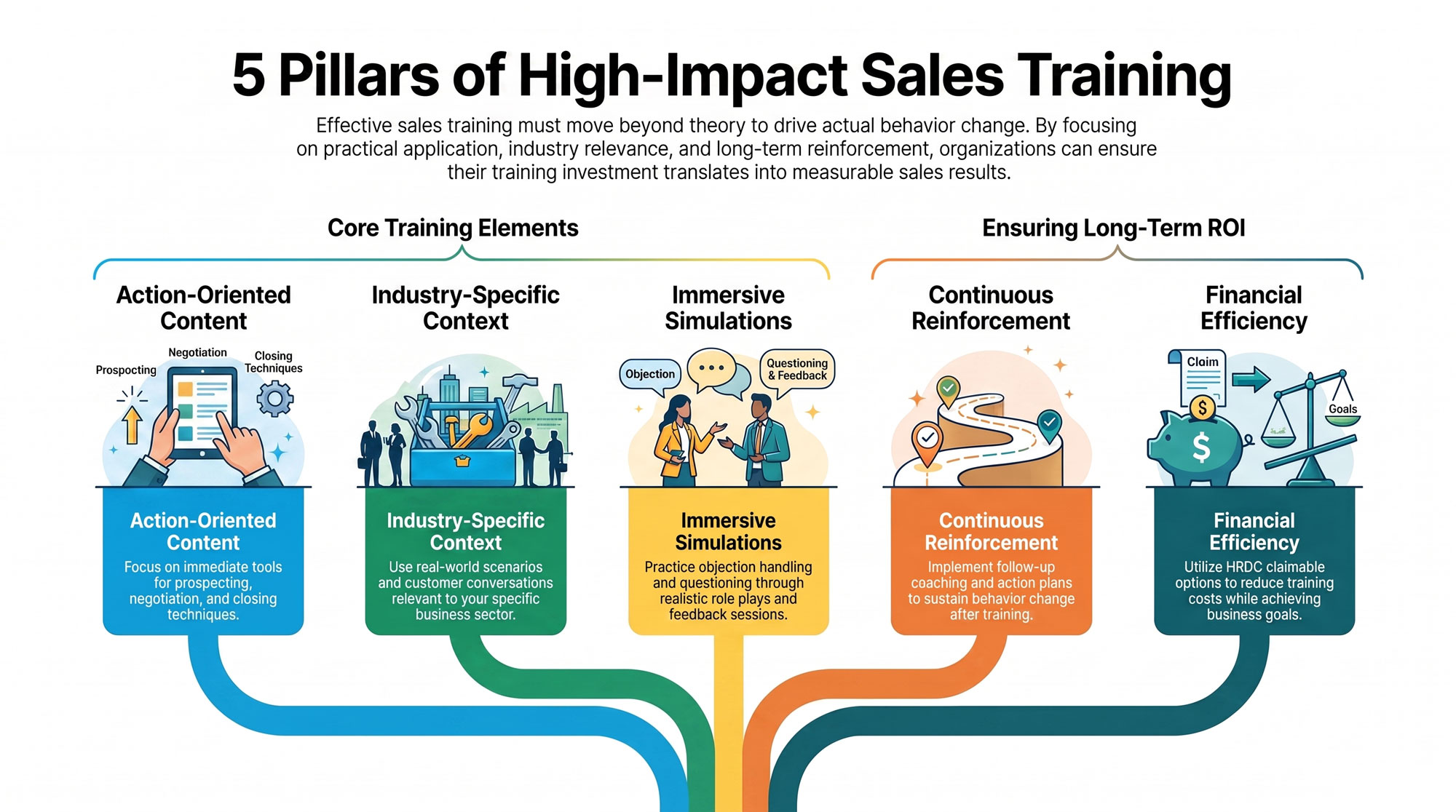
5 Things to Look for in a Sales Training Program
1. Practical and Actionable Content
The best sales training programmes focus on practical application rather than theory.
Participants should leave with tools they can apply immediately, including:
- Prospecting techniques
- Questioning frameworks
- Objection handling methods
- Negotiation strategies
- Closing techniques
Training should improve actual selling behaviour, not just increase knowledge.
2. Industry-Relevant Examples
A manufacturing company faces very different sales challenges compared to a software company or a logistics provider.
Look for programmes that can incorporate:
- Industry-specific scenarios
- Real customer conversations
- Common objections faced by your team
- Relevant case studies
This improves engagement and learning retention.
3. Role Plays and Simulations
Sales is a skill that improves through practice.
Role plays allow participants to:
- Practice handling objections
- Improve questioning techniques
- Build confidence in presentations
- Receive coaching and feedback
The more realistic the simulation, the greater the impact after training.
4. Post-Training Reinforcement
One of the biggest reasons training fails is the lack of reinforcement after the programme ends.
Effective providers often include:
- Follow-up coaching sessions
- Action plans
- Manager reinforcement tools
- Performance tracking recommendations
Learning should continue after the classroom session.
5. HRDC Claimable Options
For levy-paying employers, choosing an HRDC claimable sales training programme can significantly reduce training costs.
Many organisations today prioritise programmes that can be claimed through available HRDC schemes while still delivering measurable business results.
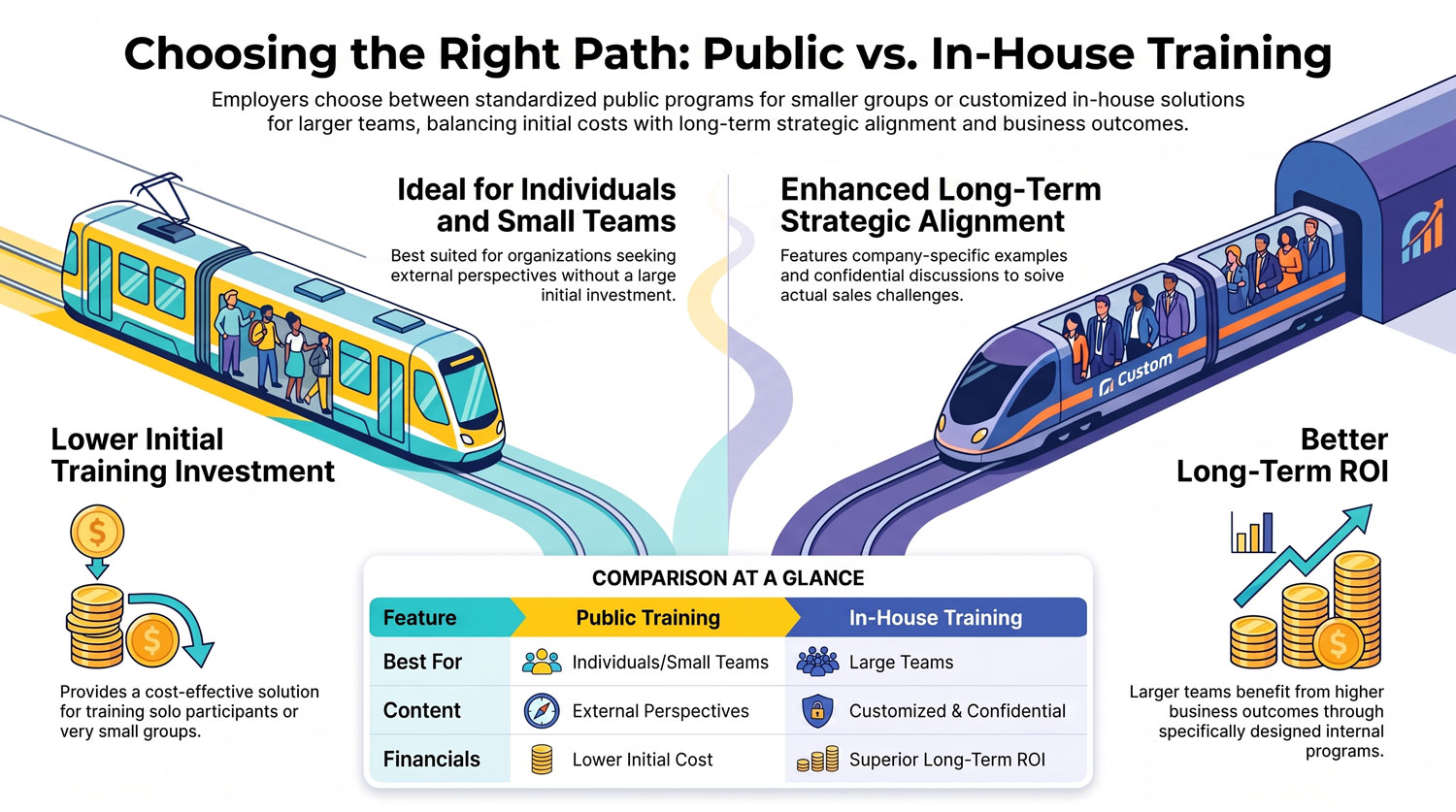
Public Training vs In-House Training
Public Training
Public programmes are often suitable for:
- Smaller teams
- Individual participants
- Organisations seeking external perspectives
- Lower initial training investment
In-House Training
In-house programmes are typically more suitable when organisations want:
- Company-specific examples
- Customised content
- Team alignment
- Confidential discussions
- Better long-term ROI
For larger teams, customised in-house training often delivers stronger business outcomes because the programme can be designed around actual sales challenges faced by the organisation.
Signs Your Sales Team May Need Training
- Falling conversion rates
- Difficulty handling objections
- Inconsistent sales processes
- Low confidence during customer presentations
- Weak follow-up discipline
- Increasing competitive pressure
Conclusion
The best sales training programme is not necessarily the cheapest or the most popular.
It is the programme that aligns with your business objectives, addresses your team’s challenges, and creates measurable improvements in sales performance.
As customer expectations continue to evolve, organisations that invest in developing their sales teams will be better positioned to strengthen customer relationships, improve competitiveness, and achieve sustainable growth.